
Whose job it is, and when it changes hands
The developer’s
Building it
To the certified plan and the approved engineering plans.
BondUncompleted works bond usually 150% of what's left, so the statement of compliance can issue early.
Still the developer’s
Looking after it, 3 months to 2 years
The Act sets 3 months unless another period is agreed. Many councils set 12 months for civil works, and landscaping runs about two years.
BondMaintenance bond often 5% of road and drainage works; landscape bonds run higher.
Council’s
For good
After the period, maintaining the works becomes council's responsibility, under the Act.
BondBond back after the final inspection.
Before the works start
The planning permit comes first. Then the Subdivision Act has the plan of subdivision certified by council and the engineering plans approved before any works begin. A certification lasts five years.
Practical completion
In the growth-area councils’ manual, practical completion means “the Works are complete except for minor outstanding works and minor defects”, agreed at an inspection with council’s supervisor; Melton has the developer request it. Councils using the Infrastructure Design Manual call the same step Acceptance of Works, and confirm it by letter.
The statement of compliance
Under the Act, council must issue it once the permit’s requirements are met, or there’s an agreement to secure them, and the plan is registered when the applicant provides it. The growth-area manual asks for the works to have reached practical completion or for council to have accepted a bond for what’s left. When the plan is registered, its roads vest in council.
How long the maintenance period is
The Act’s words: “The applicant is responsible for the maintenance of the completed works in good condition and repair for 3 months or any other period which is agreed between the applicant and the Council or referral authority.” After it, maintenance becomes council’s.
In practice it varies. Melton generally runs civil works for 3 months from titles; Hume moved to 12 months for works titled from 1 July 2025, and the Infrastructure Design Manual sets 12. Landscaping is about two years everywhere: a minimum of 24 months in both manuals, two years at Melton and Geelong.
Handover
At the end of the period the developer asks for a final inspection, and council then takes over the works. Councils on the Infrastructure Design Manual send a Letter of Release; Casey sends an End of Maintenance letter, after which the bond can be released.
Some landscape steps follow the seasons: Hume won’t put landscaping on maintenance between 1 November and 31 March, and Geelong takes no landscape handovers between 30 November and 1 March.
The two bonds
The uncompleted works bond lets the statement of compliance issue before every work is finished. The growth-area manual, Melton and Wyndham’s landscape bonds all use 150% of the cost of what’s left; the Infrastructure Design Manual uses $5,000 or 1.5 times the cost, whichever is greater, and treats bonding “only as a last resort”.
The maintenance bond is 5% of road and drainage works in both manuals. Landscape bonds run higher: 35% of the landscape cost at Hume and Wyndham.
Where it goes wrong
The final inspection is the developer’s to request. A period that ends quietly just keeps going, with the bond still held and the works still the developer’s to maintain.
The seasons make it worse. Miss Geelong’s window at the end of November and a landscape handover waits until March. Across every stage of every development, with civil and landscape works on different clocks, the dates are easy to lose.
Keeping track of it in FRED Planner
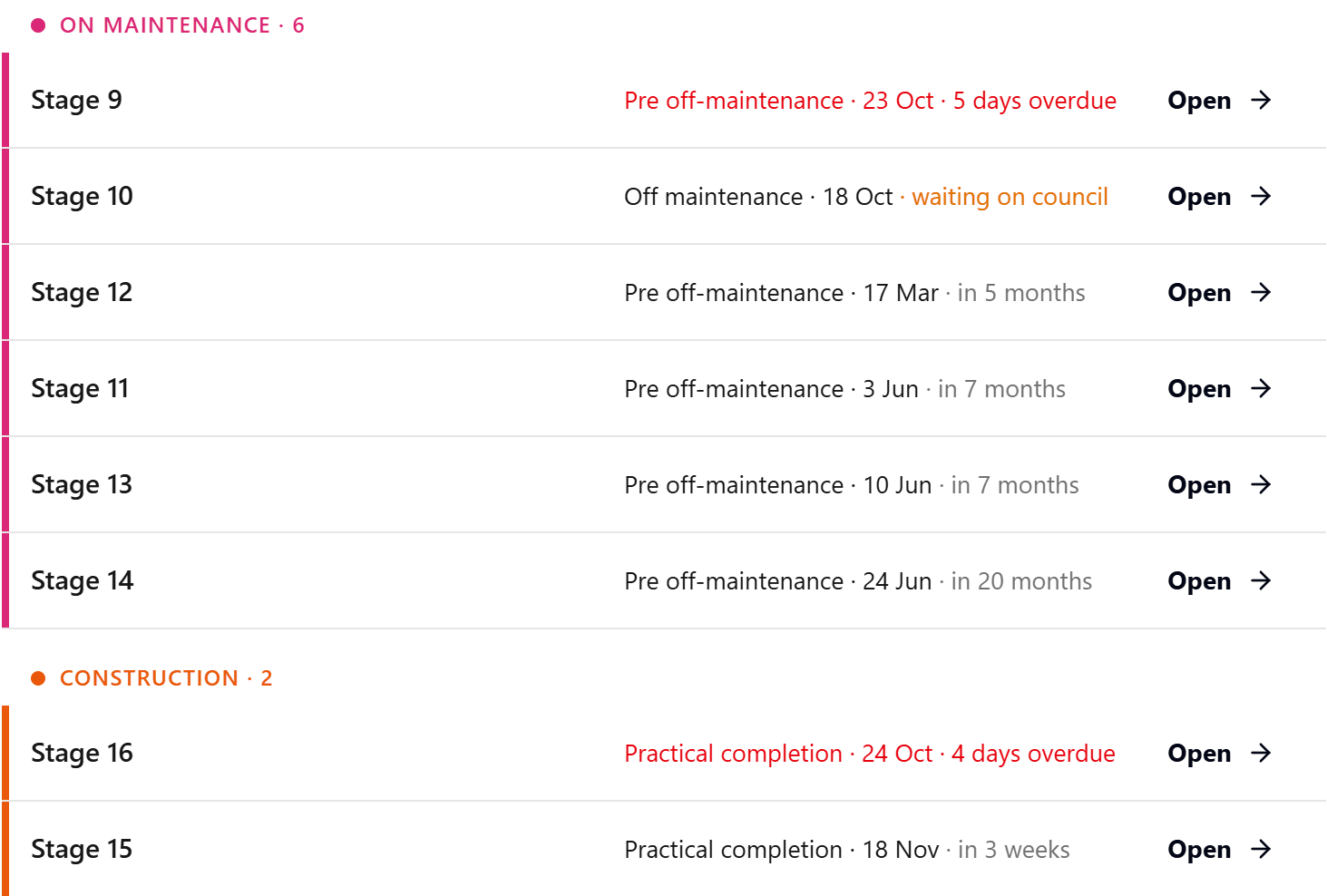
Each stage in FRED Planner keeps its dates from the letters council sends: practical completion, the statement of compliance, when the maintenance period ends, the inspection before it, and each bond with when it comes back. Forward a letter to your company’s FRED address and it reads it and files it on its stage.
So the stage list shows what’s overdue, what’s coming, and which stages are waiting on council. Its screens use Queensland’s words for now, on and off maintenance; the dates and the bonds behind them are the same.
Sources
Councils change their processes. Your approval’s conditions and your council have the final word.
- Subdivision Act 1988 (Vic)
- Victorian Planning Authority: Engineering Design and Construction Manual (2019)
- Infrastructure Design Manual, version 5.6 (2025)
- City of Melton: Subdivision construction
- City of Melton: Subdivision post construction
- Hume City Council: Changes to subdivision engineering and landscape processes
- Hume City Council: Landscape construction and on-maintenance requirements
- City of Casey: Bonds process
- City of Greater Geelong: Practical completion, maintenance and handover
- Wyndham City: Landscape bonds and fees guidelines