
Whose job it is, and when it changes hands
The builder’s
Building it
The work the contract or approval asks for.
BondSecurity or retention, held against the contract.
Handed over, defects still the builder’s
Fixing what’s wrong, often 12 months
The work is in use. Whoever built it comes back to repair defects as they’re found.
BondRetention often part of it, held until the end.
The owner’s or council’s
For good
Looked after from here by whoever now owns it.
BondSecurity back once the defects are closed.
What it’s for
Some defects only show once the work is in use: a pavement that settles, a drain that doesn’t run, plants that don’t take. The period gives the owner a set time to report them and has the contractor return to fix them, usually while some of the contractor’s money is still held.
It comes from the contract, not from a national law. Procore’s guide describes it as a contract clause, and that’s why the length, the security and the steps at the end all differ from one job to the next.
When it starts
Usually at practical completion, when the work is handed over. On subdivision works it’s often set by council’s own step: in the Northern Territory the Practical Completion Letter starts it, in the ACT the Certificate of Operational Acceptance does, and in Cockburn, WA, it starts after council accepts the works. Check which date your contract or conditions use, since every later date counts from it.
How long is a defects liability period?
Procore’s guide puts it at 6 to 24 months, with 12 months the most common. On subdivision works, councils and guidelines set their own, and landscape often differs from civil:
| Where | How long |
|---|---|
| Liverpool, NSW | Minimum 12 months |
| Newcastle, NSW, landscape | 24 months, called an establishment and maintenance period |
| Western Australia, IPWEA guidelines | 12 months from practical completion; public open space at least 2 years |
| Playford, SA | 12 months, civil and landscape counted separately |
| Kingborough, Tasmania | 6 months from completion |
| ACT | 52 weeks; soft landscape has at least a 26-week consolidation period |
| Northern Territory | 24 months for public infrastructure; 12 months for soft landscaping |
Queensland’s regulator, QBCC, adds a fallback for building contracts: if the contract doesn’t set a period, retention or security must be released 12 months after practical completion.
Is it the same as a maintenance period?
On a subdivision, it’s the same stretch under a different name: the developer looks after the works until council takes them. Queensland says on and off maintenance, NSW councils use both names, and the terms page lines them up. On a building contract, it sits between the principal and the contractor, and council may not be involved at all.
What closes it
Procore’s guide describes the usual close: a final inspection, the defects list signed off, a final certificate, then the retention or security released once everything is done. If rectified work fails again, a new period often applies to that work, so check what your contract says.
In Queensland, QBCC says a contractor must give subcontractors notice that the period is about to end, on its S67NC form, 10 business days beforehand, or 5 business days after being told where the period is tied to another contract. Not giving it is an offence, and so is not releasing retention without a reasonable excuse.
Does liability end when the period ends?
Not necessarily. Statutory warranties and duties can run well past it, and they differ by state and by the kind of work. It can also cut the other way. In Parkview v Futuroscop (2023), a single judge of the NSW Supreme Court found that one contract’s defects period and final certificate clauses together shut out common law damages for the cost of fixing defects that weren’t latent. As Allens notes, that turned on those clauses, and statutory claims may survive.
So what your contract says about the end of the period matters as much as its length. This page is general information and not legal advice.
Where it goes wrong
Nothing in it moves by itself. If nobody walks the job and records the defects before the period ends, the chance to have them fixed under the contract can go with it. For a developer waiting on council, the opposite happens: the period runs on, the bond stays held and the works go on being maintained at the developer’s cost.
And it’s rarely one date. A job can run several stages or separate civil and landscape periods, each with its own start, end and inspection, and between them they live in folders, a spreadsheet and somebody’s memory.
The walk at the end
A defects inspection only helps if what you found is written down clearly enough to act on. With FRED you walk the site and talk through what you see, taking photos as you go. It writes the report in your company’s own template, with the site plan and every finding pinned where it was seen, and the photos filed against it.
Keeping track of it in FRED Planner
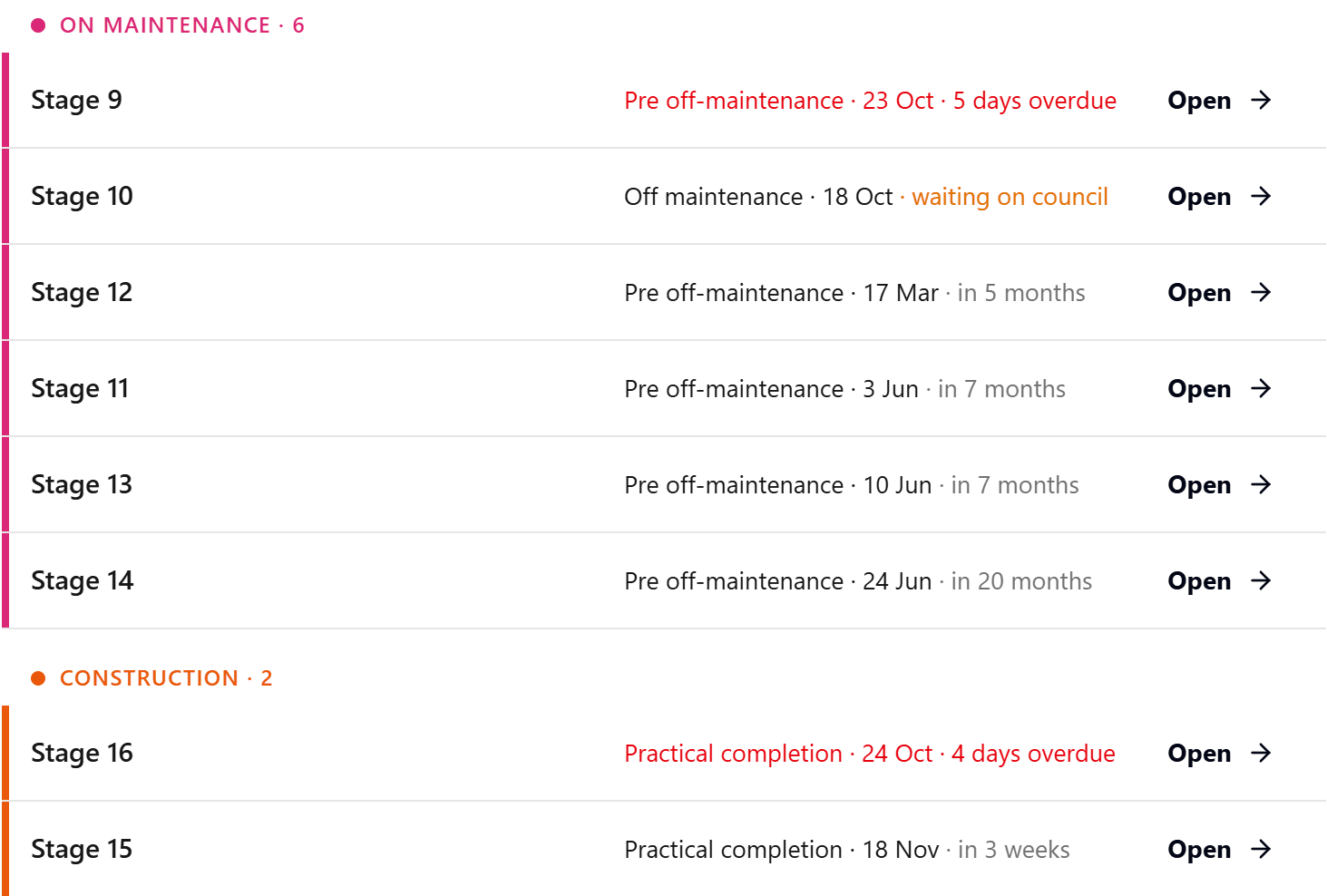
On subdivision works, each stage in FRED Planner keeps its dates from the letters and certificates council sends: when the period started, when it ends, the inspection before it, and each bond with when it comes back. Forward a letter to your company’s FRED address and it reads it and files it on its stage.
So the stage list shows what’s overdue, what’s coming, and which stages are waiting on council. Its screens use Queensland’s words for now, on and off maintenance; the dates and the bonds behind them are the same.
Sources
Councils change their processes. Your approval’s conditions and your council have the final word.
- Procore: Defect liability period
- QBCC: Retentions and defects liability
- Allens: Common law right to damages (Parkview v Futuroscop, 2023)
- Liverpool City Council: Development engineering bonds
- City of Newcastle: DCP C12, open space and landscaping
- IPWEA WA: Subdivisional Guidelines
- City of Cockburn: Land development
- City of Playford: Land Division Guidelines
- Kingborough Council: Bonding of development works
- ACT City Services: Asset assessment
- NT Subdivision Development Guidelines